Film Review: Certified Copy
At its core, the argument Kiarostami and James (played by William Shimell) make in Certified Copy is that the meaning of a signifier (a copy) does not derive from its signified (an original), but the other way around. Or more precisely: the “original” is an effect produced by copies, in line with a poststructuralist perspective.
That’s quite dry, so let me explain what I mean in plain English.
In the first half of the film, the woman played by Juliette Binoche is fawning over James, an art historian who has just published an Italian translation of his book, Certified Copy. Even her teenage son teases her about it. She is preoccupied with getting multiple copies of his book autographed, before the talk and again later in the car, as if the signature could certify those copies as authentic. She believes in authenticity: an origin that gives our lives meaning, the source of everything we value. When James gets in her car, she is giddy and tells him she can’t believe he is there.
With James sitting next to her, she feels as if the absolute origin of everything she loves about the book is finally present. The “real thing,” as opposed to words on a page pointing to him, is right beside her. But James is uneasy about her philosophy of life. She mentions that her sister doesn’t believe originals are any better than copies; she’s happy to wear forged jewelry, for instance. Electric stove versus gas? Who cares? James says he wishes he were like her, and that he wrote the book partly to convince himself that copies are just as good as originals. This is Kiarostami speaking through James. In many of his other films, he is preoccupied with what is real and what is represented.
His Koker Trilogy (Where Is the Friend’s House?, And Life Goes On, and Through the Olive Trees) is a nested, self-reflexive set of films set around the village of Koker. The first film follows a simple boy’s errand. In the second, the director of the first film travels through the region after the earthquake to find the child actors. Finally, the last film is about the making of that second film. It’s mesmerizing chain of signifiers. Through a representation of a representation of a representation, the attempt to differentiate what is real from what is represented becomes futile.
Neither Kiarostami nor James can explain why the mind habitually seeks meaning by peeling the layers of an onion to find an origin. Kiarostami keeps making films to explore the question, just as James wrote Certified Copy to convince himself that he doesn’t care about the myth of origin.
In the museum scene, James mentions the Mona Lisa, arguing that if the original were what really mattered, Lisa Gherardini, da Vinci’s model, should be more important than the painting. It’s a good example of how copies inflate the value of the original. People standing awestruck in the Louvre have seen countless reproductions in their lives; without those copies, there would be no awe to begin with. What impresses them is the idea that they are looking at the one-and-only original, as if they are being fooled by their own fiction.
Likewise, the woman is giddy about James, not because he is the origin of her excitement, but because she is utterly convinced of her own origin story. It is she who is giving meaning to James through her gaze. The signifier gives birth to the signified, not the other way around.
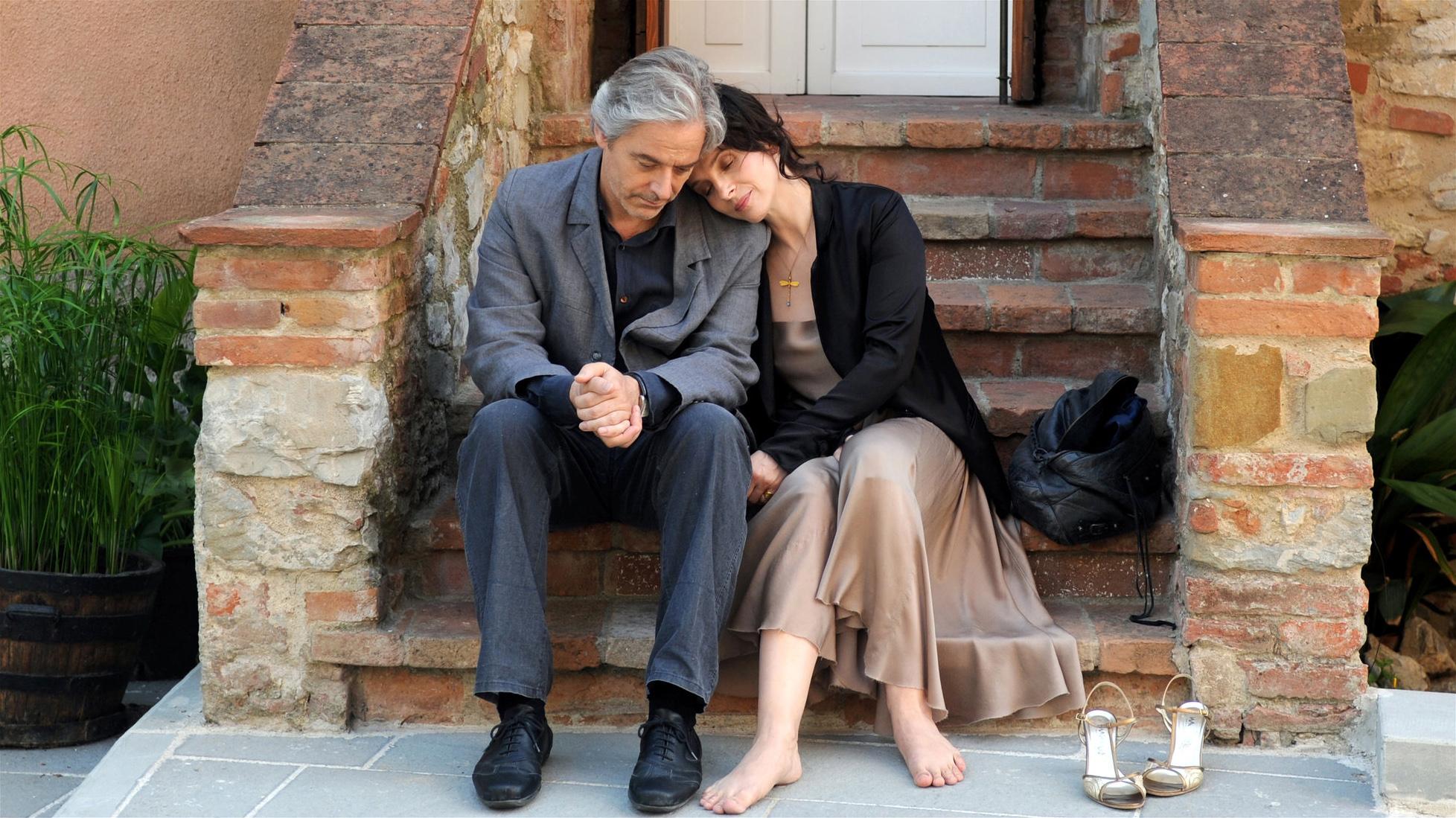
Halfway into the film, in the cafe scene, they suddenly begin acting as if they have been married for fifteen years. The shift is prompted by the cafe owner’s misunderstanding that they are a couple. The misunderstanding becomes real; an interpretation becomes the origin. Their gaze on each other changes with it. They have little Mars-vs-Venus fights one after another. She calls his book “stupid” at one point. Seeing the tension between them, an older man advises him to put his arm around her as they walk. He reluctantly obliges; he knows he is just copying the older man’s gesture.
In the restaurant scene, James is irritated by the fakeness of the wine-tasting ritual, where you’re expected to accept the bottle even if you don’t like it; why bother tasting if you can’t reject it? This shows how much he still clings to authenticity and resists inauthentic behavior. He can’t quite practice what he preaches, because he isn’t as simple as her sister.
It’s a tragic love story because they can’t live up to an original, authentic version of their love. Everything they do in the latter half is measured against that supposed original, what they had fifteen years ago. Revisiting the site of their honeymoon doesn’t restore it; it only reminds them of what they have lost. He tries to be rational and begs her to accept how they have changed, but she keeps dragging them back to the origin of their love. They can’t live as who they are now, because who they are now is always being measured against who they once were, or who they believe they once were.
The sudden shift in their relationship at the cafe isolates the true cause: not time or changing circumstances, but the gaze through which we tell our fictional stories. By keeping everything else the same, the film brings out the power of that gaze.
Subscribe
I will email you when I post a new article.